Environmental Surveillance for Everyone (ESE)
The Environmental Surveillance for Everyone (ESE) research area will develop, benchmark, and implement technologies and assays that increase access to environmental surveillance, particularly in regions that are currently underserved. The ESE team combines expertise in engineering, assay development, and public health impact. The ultimate goal of the ESE research area is to develop a cost-effective diagnostic point-of-care device that can process environmental samples and detect pathogens of interest. The team will do this by employing iterative processes that seek to simplify sample processing techniques to enable automation. ESE will work with investigators in other research areas of the center to ensure that these assays and processes are developed in a way that makes them easily accessible to citizen scientists and public health professionals alike.
The ESE team has been developing some of these technologies for years using funds from other grants. Some of these early prototypes have been deployed and validated under extremely challenging field conditions. A simplified wastewater sampling process developed by our team was taught to researchers and technicians at Uganda’s Joint Clinical Research Centre (JCRC). JCRC researchers were then able to process samples collected in Uganda to look for certain pathogens of concern. Wastewater from Uganda was also processed by both JCRC and our team to look for drug resistant bacteria in the country (findings pictured on the right).

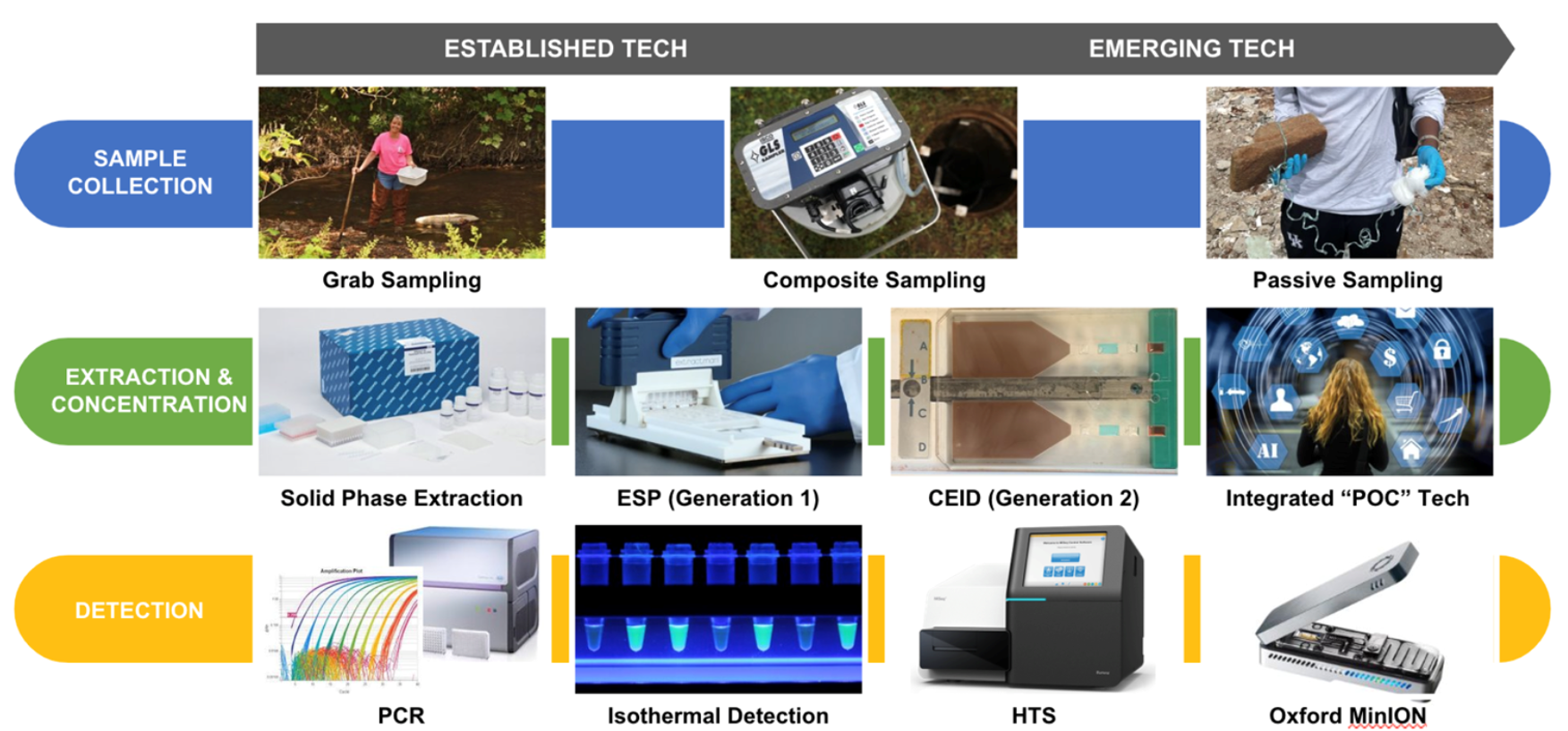
A graphic that highlights the current state of environmental surveillance technologies as well as some of the technologies currently in development by ESE investigators. ESP=exclusion-based sample preparation, POC=point-of-care, PCR=polymerase chain reaction, HTS=high throughput sequencing, CEID=concentration-extraction-identification device
Data to Decisions (D2D)
The Data to Decisions (D2D) group will support the translation of genomic data from environmental samples into information and knowledge for pandemic response and surveillance to support ESE in both low- and high-resource settings. Our team will do this using a three-pronged approach involving 1) microbial genomic and bioinformatics, 2) modeling to support clinical and public health decisions regarding pandemic preparedness and One Health, and 3) visualization of information and results for clinical and public health decision-making.
The D2D team will work with community partners to create customized online and offline pipelines for metagenomic analysis and more generic pipelines that will be shared with online communities to further the science of metagenomic analysis. They will submit their sequenced genomes to online databases like NCBI SRA and GenBank to ensure that the scientific community writ large has access to them. They will also create Geographic Information Systems (GIS) models that can be used by communities and by public health practitioners to better understand the dynamics of the spread of disease in various environments and contexts.
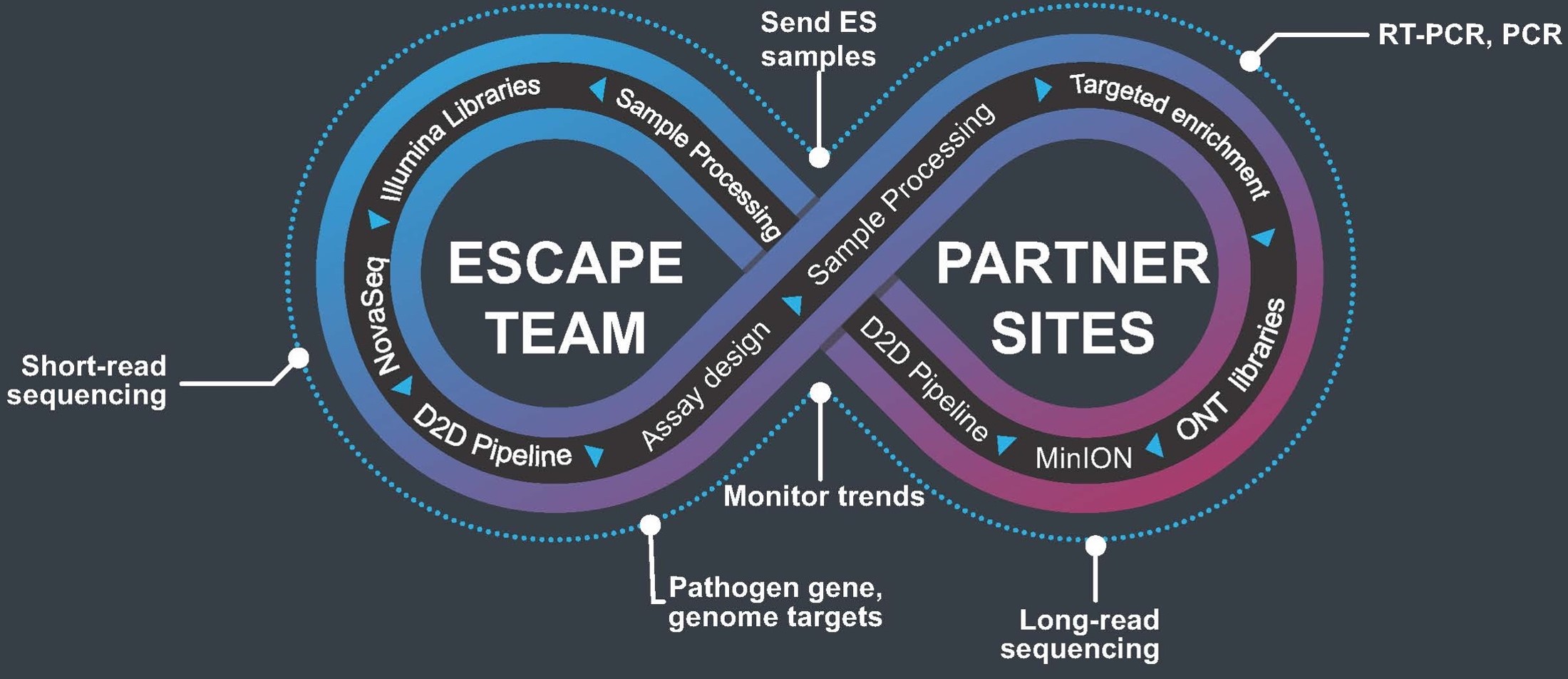
A graphic illustrating the Data to Decisions (D2D) pipeline development process
Community Science (CS)
The Community Science research team will use a co-productive approach and participatory methods to engage communities in ES and to translate Environmental Surveillance for Everyone (ESE) and Data to Decisions (D2D) across three socio-epidemiologic contexts: rural Alaska, Kentucky, and Indonesia. Our team will focus on human-environment relationships known to be possible sources of spillover and pathogen exposure (interactions with wild animals through hunting and/or wet markets, water insecurity/untreated water consumption and flooding). This participatory community science approach will enable the Center to integrate, test, and adapt the environmental assays created by the ESE team and the analytical tools developed by the D2D team.
The Community Science team will expand previous work in participatory disease surveillance to generate new sources of pandemic intelligence and actionable community data to support pandemic prevention, response, and mitigation. We envision engagement through a co-production process, partnering with the communities throughout all stages of the project. A truly co-productive process ensures that all relevant knowledge systems and knowledge holders are afforded equitable space, respect, responsibilities, and decision-making power throughout the life of a research project. By bringing Western science, community, and Indigenous perspectives together, we will attempt to create enhanced and novel understandings of environmental surveillance.